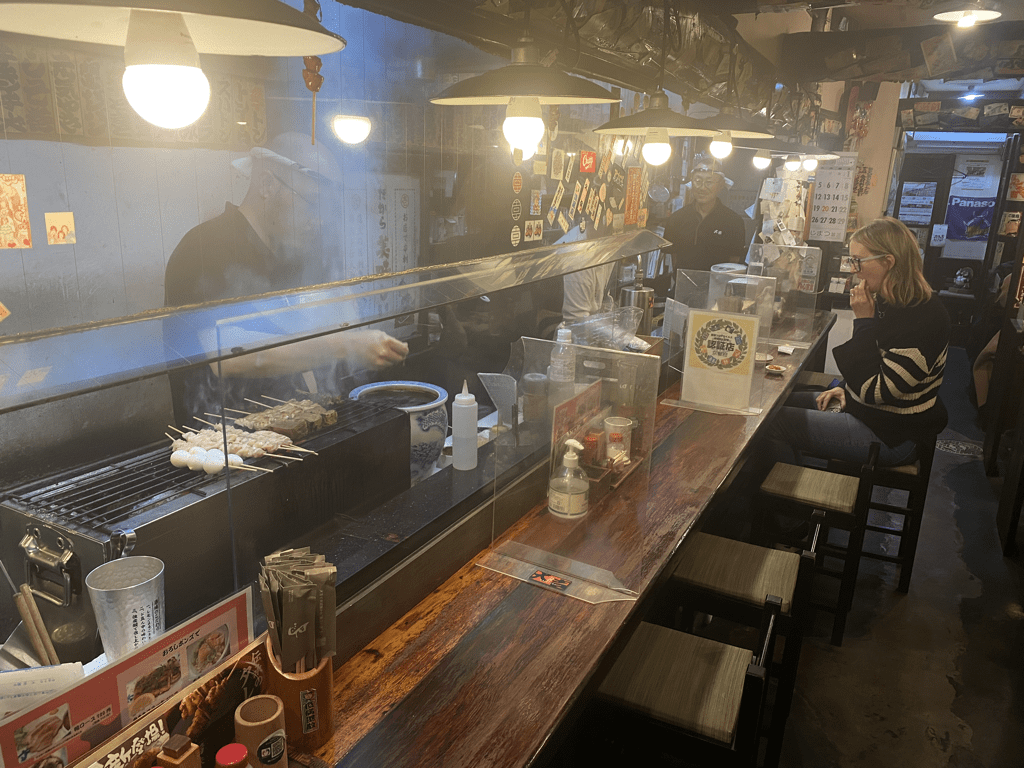
We spent four nights in Kyoto. We arrived after dark on the first night and were tired after the day’s travels. We had yakitori at a restaurant recommended by our accommodation. It was a small local place. The food was very good and atmosphere authentic.
We hired Masutami Kawaguchi of Masu private taxi for our first day in Kyoto. There is so much to see and we heard that navigating Kyoto can be challenging. We sent Masu-san a our short list of places we wanted to see leaving out places that were near where we were staying and those that we planned on seeing on day 2 (Nara) and day 3 (Arisimaya). Masu met us at 8:00 am, we fine tuned the day’s itinerary with Masu-san’s input and off we went. We had a full day with Masu-san and learned a lot from his deep knowledge of Kyoto history as well as his overall general knowledge. Hiring a guide isn’t something we typically do, but in this case with our limited time in Kyoto it allowed us to see and understand so much more than we would have been able to do on our own.
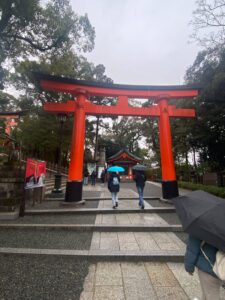
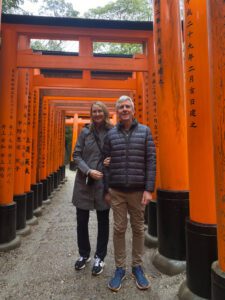
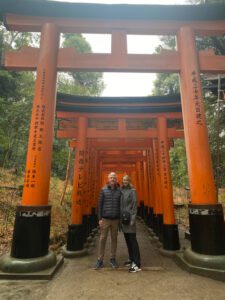
The first stop was the many golden gates of Fushimi Inari-taisha, which is known for its thousands of golden gates. This is the head shinto shrine of the kami Inari. Kami are the deities and spirits of the Shinto religion with the kami inari being the kami of rice and agriculture. Merchants also worship Inari as the patron of business. The golden gates are offerings/donations by people to the shrine, with larger gates reflecting larger donations. The fronts of the gates are smooth, while the backs have the donor’s name and date of donation inscribed in kanji or Hiragana.
The shine is located at the base of mount Inari, with thousands of gates lining a path to the summit of the mountain. It takes 2 to 3 hours to walk the entire path so we just did a portion of the trail. We arrived around 8:30 and there were already a fair number of people milling about.

The second stop of the day was a Buddhist temple known as Sanjusangen-do temple. This temple was not on our original list, but was recommended by Masu-san. I particularly was glad we did as this ended up being one of my favorite sites of the day. Sanjusangen-do translates to a hall with thirty-three spaces between columns, which describes the very long main hall which houses 1001 statutes of Kanon, the goddess of compassion, 28 guardian deities, statues of the Thunder God and Wind God, and one large seated statue of a thousand-armed Kanon. The statues are all made from Japanese cypress that is then coated with a black lacquer finish with gold leaf applied on the lacquer. The temple was established in 1164 by a warrior-politician in honor of the many lives that were lost to a famine. The original temple was lost in a fire, but 124 of the original statues were saved and were then supplemented with 876 additional statues to make up for those that had burned when the temple was rebuilt in 1266. The temple and statutes are listed as National Treasures of Japan. Photos are not permitted inside so it is difficult to convey how the impact of the statutes all lined up and facing you as you walk the length of the building, but some photos and additional information can be found here.
Another interesting fact of Sanjusangen-do is that it became the site of archery competitions. Contestants would stand at one end of the exterior of the building under the overhang and shoot at a target at the far end approximately 120 meters away. Given the great distance, the arrows would need to be launched with great force and minimal arc in order to hit the target. In fact many arrows would get stuck in the ceiling rafters (one still remains) and columns of the hall. The side of the columns facing the archers were eventually clad with metal.
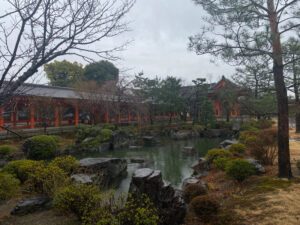
Unfortunately, I was not good about capturing the surroundings with photos so all I have are a couple photos of the garden and pond outside the main hall.

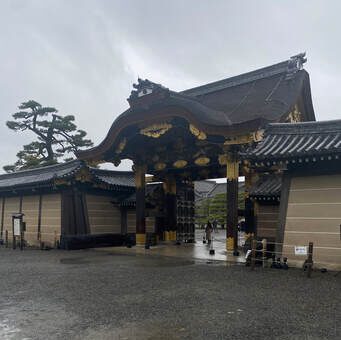
The next stop was Nijo-Jo Castle, a UNESCO World heritage Site. The castle was completed in 1603 and was built as the Kyoto residence of the Shogun when he visited Kyoto. The castle complex consists of a palace consisting of six connected buildings that were used by the Shogun to conduct business. We learned about the flow of visitors through the palace and the significance that was placed on where people saw the Shogun and how close they were allowed to get to him. Again no pictures were allowed inside the building so all I have is a single photo of the main entry gate.
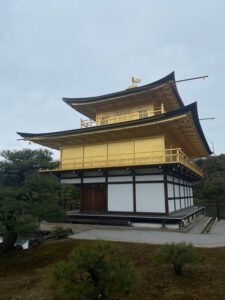
Our third stop was Kinkaku-ji Temple that is commonly referred to as the Golden Pavilion because its top two floors are covered in gold-leaf. Kinkaku-jim Temple, a UNESCO World Heritage site was built in 1397 in the compound that a powerful shogun used in his retirement. The original building was burned down by a mentally ill monk in 1950. The present structure was rebuilt in 1955, with the gold leaf replaced again in 1986 with thicker gold leaf because the earlier application was wearing off. Each of the three floors represents a different style of architecture. The bottom floor is in the imperial style and is the only floor that is not covered in gold, with some saying that this was an intentional act by the shogun to show his disdain of and power over the emperor.

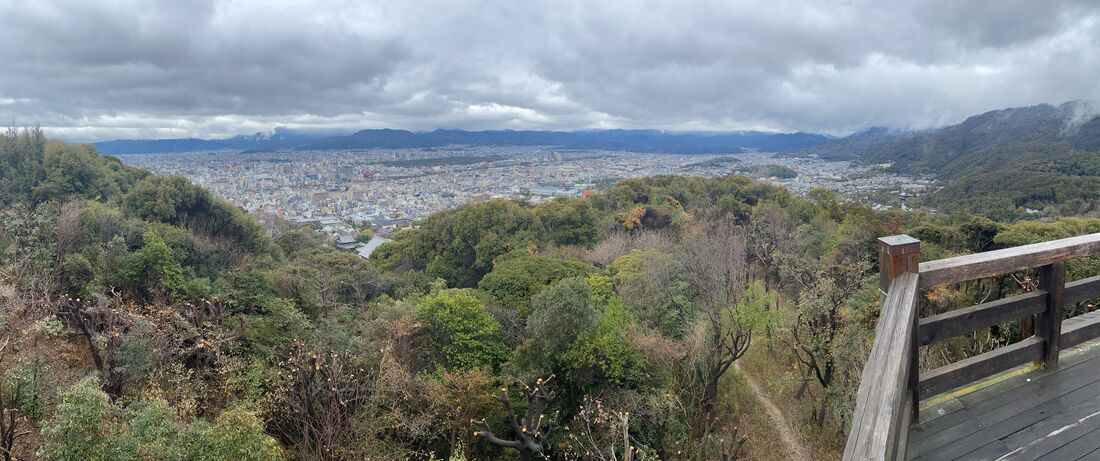
We stopped for a late lunch at Honke Owariya, a 540 year old soba Restaurant in Kyoto, and then made our last stop at Seiryu-den. This temple is located on the summit of Mt. Higashiyama and is known as the place to come for a view of Kyoto. There is a large observation deck that affords a spectacular view of Kyoto and surroundings. From this vantage point we were even able to make out the high rises of Osaka off in the distance.
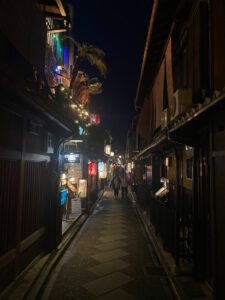
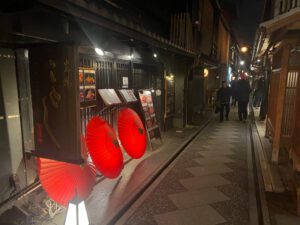
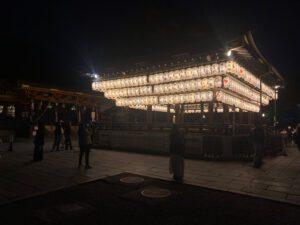
We were tired after all that activity so had a few hours of down-time in the afternoon. We ventured out in the evening to see the sites of the Gion district at night since we were staying in general vicinity. The Gion district is a heavily touristed area of Kyoto that originated as an entertainment district and still houses many teahouses where geiko and maiko (types of Geisha) can be found. We walked around for a bit, but didn’t come across any geisha and also didn’t find a place to eat that suited our criteria of having at least some gluten free offerings without focusing on Kobe beef. We eventually settled on a tempura place called Tendon Restaurant Loosen Up near our airbnb, and were happy with the choice.
Angie woke up in the night with a slight fever and wasn’t feeling well in the morning so we stayed in for a bit to readjust plans. She started to feel a bit better, so we decided to venture down to Nara in the afternoon and leave exploring Arishiyama for the next day. Nara gets its own post, but I’ll add Arishiyama to this post. I ventured out there by myself on Friday, March 7, our third full day in Kyoto, since Angie needed a full day of rest.
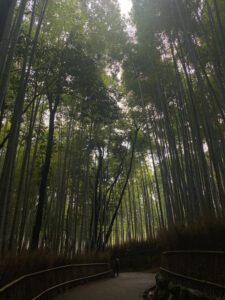
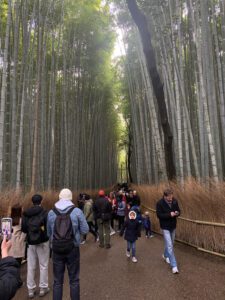
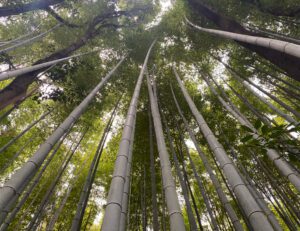
Arishiyama is a neighborhood on the north west side of Kyoto. It is most known for its bamboo forest and monkey park. The monkey park is an area carved out of the surrounding forest where people are allowed to feed the Japanese macaques from inside a building that has been built into a clearing. I’ve read mixed reviews of the monkey park and since we had a great visit with them at the snow monkey park, I decided to skip the monkey park in Arishiyama. I did venture through the bamboo forest, which was nice, but felt somewhat overrated. I enjoyed walking around the neighborhood and visited two of the many shrines and temples along the foothills.
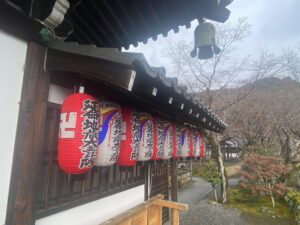
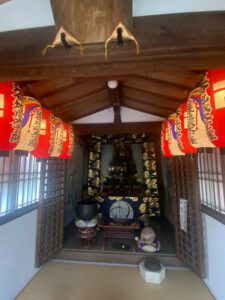
I enjoyed my time at Adashino Nenbutsuji Temple. This temple was founded in the early 9th century and consists of hundreds of stone statutes. It also contains a small bamboo forest that some sources say can be less crowded than the main bamboo forest. It was less crowded, but it certainly wasn’t a hidden spot.
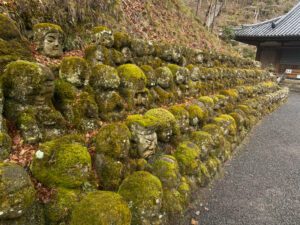
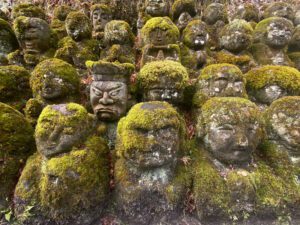
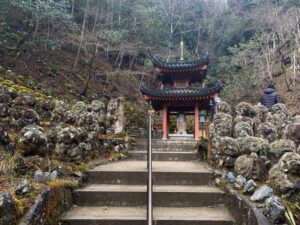
I then visited Otagi Nenbutsuji Temple that is know for its 1200 stone statues that were carved by students of the head monk of the temple in the 1980s and 1990s. While recent additions, the variety of facial expressions of the statutes made for a fun visit.
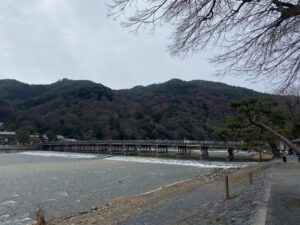
It was then back to the main part of Arishiyama where I had a bowl of Udon and tempura for lunch, a quick visit to Tegetsukyo bridge and then a bus ride back to toward our Airbnb. I took a slight detour and walked part of the Philosopher’s path, a short path that is known for its views during cherry blossom season. We were early for the cherry blossoms, but the path and winding my way back to our place was very pleasant. Angie was feeling good enough that we ventured out and enjoyed a dinner of gluten free, soy milk ramen from Gion Soy Milk Raen Uno Yokiko. The creamy flavorful broth was a new take on ramen and so delicious.